In short
- GEO pricing has no universal tariff, but First Page Sage reports a $6,850 median GEO/AEO retainer and a $4,500 median published starting price.[1]
- Retainers are common, while agencies also use audits, projects, hourly consulting, performance-based pricing, and bundled GEO services.[7][1]
- Public 2026 offers range from CITEWERK’s €490 monthly entry package and Jumpstart GEO’s $200 per-location plan to multi-thousand-dollar retainers and implementation packages.[3]
- Agencies should price by clearly stated scope—brand, location, prompts, content assets, markets, reporting, and implementation—not by an unexplained promise of AI visibility.[6]
- Tool cost per client should be shown separately from labor and overhead, and no gross-margin percentage should be claimed without the agency’s own delivery-cost data.[7]
Table of contents
Agencies should price GEO services around a clearly defined unit of work—not a vague promise of “AI visibility.” The strongest model is usually a paid diagnostic followed by a project or retainer that specifies prompts, markets, content assets, citations, reporting, and tool capacity. Public 2026 benchmarks show a wide market: First Page Sage reports a median GEO/AEO retainer of $6,850 per month, while published packages range from several hundred dollars per month to several thousand.[1]
GEO pricing is still developing. One study of 47 people at 46 B2B agencies found that 38% used ongoing retainers, 21% bundled GEO into existing fees, 17% used projects or one-off work, and 4% did not charge separately.[2] These findings describe different research samples and should not be treated as a single market tariff.
What should a GEO service include?
A GEO offer should connect measurement to action. Depending on the client, that may include:
- Prompt and query research
- Visibility, mention, citation, and competitor tracking
- Technical crawlability checks
- Content briefs and content optimization
- Digital PR or citation-building work
- AI crawler and referral analytics
- Monthly reporting and recommendations
- Strategy calls and implementation support
The scope should state what the client receives each month. CITEWERK, for example, separates packages by content volume, citation tracking, digital PR, citation building, and reporting.[3] Jumpstart GEO defines its plans by location, tracked search terms, and monthly content pages.[4]
A useful proposal names the billing unit explicitly:
- Per month
- Per project
- Per location
- Per brand
- Per prompt set
- Per content asset
- Per consulting hour
That distinction matters because a $2,000 monthly retainer for one brand in one market is not equivalent to a $2,000 package covering ten locations or multiple brands.
What do GEO services cost in 2026?
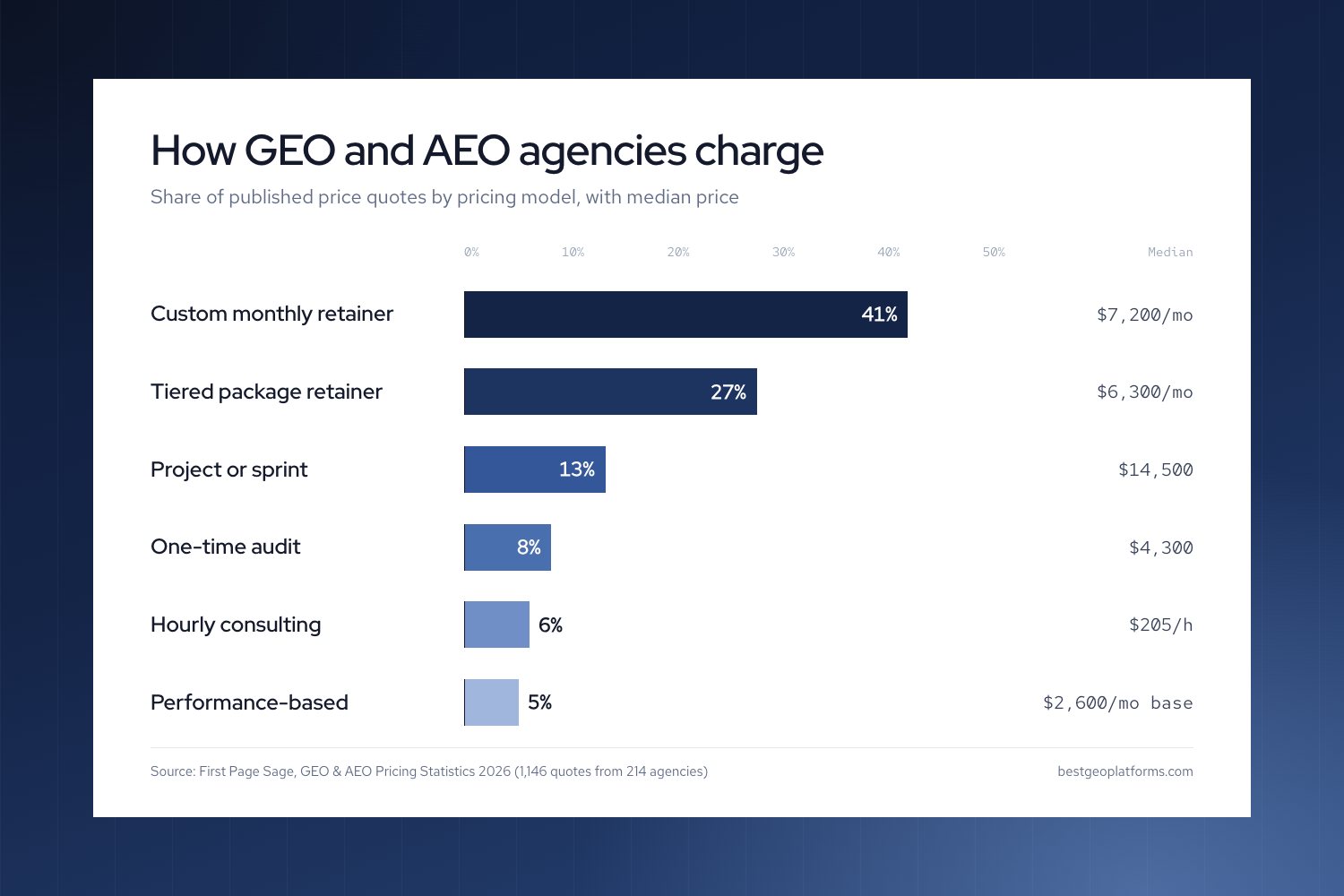
There is no single standard rate, but published research provides useful anchors. First Page Sage reports 1,146 GEO/AEO price quotes from 214 agencies and lists a $6,850 median overall retainer, with a $4,500 median published starting price among the agencies it reviewed.[1]
Its pricing-model data shows how widely the market varies:
| Pricing model | Share reported | Median price | Typical duration |
|---|---|---|---|
| Custom monthly retainer | 41% | $7,200/month | Typically 6 months[5] |
| Tiered package retainer | 27% | $6,300/month | Typically 3–6 months[5] |
| Project or sprint | 13% | $14,500/project | Typically 30–90 days[1] |
| One-time audit | 8% | $4,300 | Typically 2–6 weeks[1][6] |
| Hourly consulting | 6% | $205/hour | Not published[1][7] |
| Performance-based | 5% | $2,600/month base | Typically 6–12 months[1] |
These medians are research benchmarks, not mandatory rates. First Page Sage compiled quotes, proposals, and signed contracts, so the figures should be presented as market observations rather than a universal price list.[1]
Public offers show an even broader range:
- CITEWERK lists a €350 visibility audit and monthly packages of €490, €1,490, and €3,500.[3]
- Bowen AI Strategy Group lists GEO at $2,500 for the first month and $2,000 per month thereafter; a combined GEO and Google SEO offer starts at $4,500 and continues at $4,000 per month.[8]
- Jumpstart GEO lists monthly plans from $200 to $1,000 per location, plus initiation fees from $400 to $1,500.[4]
- AEO HQ lists fixed-fee services from a $499 instant audit to an $8,995 blueprint and implementation package.[9][7]
The range reflects differences in research depth, implementation, content production, market coverage, reporting, and ongoing strategy—not simply different agency margins.
Which GEO pricing models work best?
Retainers
Retainers suit clients that need continuous monitoring, content production, testing, and iteration. First Page Sage reports custom and tiered retainers as its two largest pricing categories, representing 41% and 27% of the models in its research.[1]
A retainer should define:
- Number of tracked brands or locations
- Prompt or query coverage
- Engines and markets monitored
- Monthly content or optimization output
- Citation or digital PR activity
- Reporting cadence
- Strategy and implementation hours
- Included software capacity
- Minimum term and cancellation terms
Retainers are easier to defend when the agency sells an operating system rather than a dashboard. The client should understand what happens between monthly reports.
Fixed-fee audits
An audit is useful as a low-commitment entry product. It can examine current mentions, citations, competitors, prompt coverage, technical accessibility, and content gaps.
A fixed-fee audit should end with tangible deliverables:
- Baseline visibility snapshot
- Priority prompt set
- Competitor comparison
- Citation and source analysis
- Technical findings
- Content and digital PR opportunities
- Recommended implementation roadmap
AEO HQ separates instant audits, full audits, blueprints, and implementation, with published prices from $499 to $8,995.[9][7] This staged structure lets an agency charge for diagnosis before proposing a larger engagement.
Projects and sprints
Projects are appropriate when the client wants a defined transformation, such as rebuilding an information architecture, optimizing a content cluster, or preparing a new market.
First Page Sage reports a $14,500 median for project or sprint work, typically lasting 30–90 days.[1] A project proposal should specify the start and end state rather than promise a particular AI ranking.
Bundled GEO
Some agencies include GEO inside an existing SEO, content, or digital PR retainer. Demand-Genius reports that 21% of its surveyed respondents bundle GEO into existing fees.[2]
Bundling can reduce sales friction, but it creates a measurement problem if the client cannot distinguish GEO work from the rest of the engagement. Agencies should document the additional GEO outputs and explain whether tool costs, prompt research, and reporting are included.
Performance-based pricing
Performance pricing can align incentives, but AI visibility is affected by engine changes, query variation, competitors, citations, and domain-specific factors. The academic GEO study reports visibility improvements of up to 40% in its benchmark, while also finding that results vary across domains; it does not establish a guaranteed client outcome.[10] Finseo’s own review of replication work found that the 40% GEO lift is rank-dependent: the same edit moved a rank-5 page +115% and a rank-1 page −30%.
If performance pricing is used, define the measurement precisely:
- Which engines count
- Which prompts count
- Whether mentions and citations are measured separately
- How often results are sampled
- What baseline applies
- What happens when an engine changes its answer behavior
A hybrid model—a base fee plus a defined performance component—is easier to operate than a fee based only on an uncertain outcome.
How should an agency package GEO services?
Use packaging to turn an ambiguous service into a sequence of understandable decisions.
- Sell the diagnostic first. Establish the client’s current visibility, competitors, citations, content gaps, and technical issues before quoting an ongoing program.[11]
- Choose the coverage unit. State whether the package covers one brand, one domain, a number of locations, a market, or a defined prompt set.[5]
- Define the monthly outputs. List content pages, briefs, technical fixes, digital PR actions, reporting, meetings, and recommendations.[9]
- Separate measurement from implementation. A tracking subscription is not equivalent to content production, technical work, or citation building.[7]
- Set change rules. Specify how additional markets, brands, prompts, content assets, and strategy hours are priced.
- Add a review point. Use a 30-, 60-, or 90-day review to assess data quality, coverage, and priorities rather than promising a fixed visibility result.
- Show the software allocation. State the tool included in the package, its capacity, and whether the agency absorbs or passes through the cost.
A practical three-stage menu could contain:
| Stage | Commercial purpose | Typical deliverables |
|---|---|---|
| Diagnostic | Paid entry point | Audit, baseline, prompt set, competitor and citation analysis |
| Foundation project | Defined implementation | Technical fixes, priority pages, structured content, tracking setup |
| Ongoing retainer | Continuous improvement | Monitoring, content, digital PR, reporting, testing, and strategy |
The exact fee should follow the scope. Published examples support the structure, but they do not justify inventing a universal price for each stage.[5]
How much should agencies allocate for GEO software?
Tool cost should be calculated separately from delivery labor. Public plans use different units, so a direct comparison requires care.
| Platform or plan | Published price and capacity | Implied software allocation |
|---|---|---|
| Peec AI Agency Essential | $245/month for 3 live client projects[12] | $81.67 per project/month when all slots are used[13][12] |
| Peec AI Agency Growth | $495/month for 10 live client projects[12] | $49.50 per project/month when all slots are used[12] |
| Peec AI Agency Scale | $795/month for 25 live client projects[12] | $31.80 per project/month when all slots are used[12] |
| SignalorAI per-brand plan | £69.99/month for 10 prompts or £99.69/month for 25 prompts[14] | Published per-brand rate; final agency allocation depends on workspace use |
| AIO Fusion Agency | £417/month billed annually for 3 Premium projects[15] | £139 per included project/month when all slots are used[15] |
| OtterlyAI plans | €29, €189, and €489 monthly plans tied to prompt allowances[16] | Per-client cost not published[16] |
Peec’s figures are calculated allocations, not extra charges. They assume every included project slot is filled and do not include agency labor, account management, content production, or overhead.[17][6]
AEO HQ’s pricing index gives a broader monitoring-software range of $29–$999 per month, but that is a subscription range rather than a universal per-client cost.[7] Where a vendor does not publish client capacity or a per-brand rate, the agency should label the client allocation as not published instead of guessing.
<details>
<summary>How to calculate tool cost per client</summary>

Divide the monthly platform fee by the number of client projects or brands the plan actually supports. For example, a $495 plan with 10 included live projects produces a $49.50 platform allocation per fully utilized project. Keep this separate from labor, content, account management, and other overhead.

</details>
How can agencies protect GEO margins?
Gross margin cannot be inferred from a public retainer and a software price. The reviewed research publishes agency fees and some platform plans, but not the agencies’ labor inputs, overhead, utilization, or fully loaded delivery costs.[5][18]
Agencies should calculate their own delivery economics using:
- Estimated strategy hours
- Research and analysis hours
- Content production hours
- Technical implementation hours
- Account management time
- Software allocation
- Freelance or contractor costs
- Sales and onboarding time
- Revision and approval time
- Overhead allocation
- Expected utilization
A simple internal model is:
[ \text{Delivery cost} = \text{labor cost} + \text{software allocation} + \text{contractor cost} + \text{allocated overhead} ]
[ \text{Gross margin} = \frac{\text{service price} - \text{delivery cost}}{\text{service price}} ]
The formulas are internal planning tools, not published market benchmarks. If labor and overhead are unknown, the resulting margin is unknown and should not be presented as a market fact.
Which pricing unit should an agency use?
The best unit depends on the work being sold.
- Use per project for audits, blueprints, migrations, and defined implementation.
- Use per month for monitoring, content operations, reporting, and ongoing strategy.
- Use per location when local presence and market coverage drive the workload.[6][4]
- Use per brand when each brand has separate prompts, competitors, and reporting.
- Use per prompt set when research and monitoring volume are the primary cost drivers.
- Use per asset when the offer is mainly content briefs, pages, or technical recommendations.
- Use hourly consulting for advisory work with uncertain scope.
Do not combine units without explanation. A “$1,000 monthly package” should say whether that means one brand, one location, ten prompts, four content pages, or a fixed number of consulting hours.
How should an agency present a GEO proposal?
A proposal should make the commercial logic visible:
- Current-state diagnosis
- Business objective
- Coverage definition
- Deliverables by month
- Client responsibilities
- Included software and capacity
- Timeline and review points
- Exclusions and change fees
- Reporting method
- Price and billing terms
Avoid claiming that a specific fee guarantees rankings, citations, or a fixed share of AI answers. The KDD 2024 GEO research found that optimization outcomes vary across domains, so a responsible proposal should promise work, measurement, and iteration rather than an unsupported visibility result.[19][7]
The proposal should also distinguish between tracking and improvement. A platform may provide prompts, metrics, competitors, and sources, while the agency adds interpretation, content, technical changes, digital PR, and client coordination. Those are different cost centers and should not be hidden inside a single unexplained software line.
Frequently asked questions
How much does GEO cost?
Published GEO and AEO prices range from low-cost audits and location-based packages to multi-thousand-dollar retainers. Examples include CITEWERK packages from €490 to €3,500 per month, Bowen’s GEO offer at $2,500 for the first month and $2,000 thereafter, and AEO HQ fixed-fee services from $499 to $8,995.[7][9]
What is a typical GEO retainer?
First Page Sage reports a $6,850 median GEO/AEO retainer, with custom retainers at a $7,200 median and tiered retainers at a $6,300 median.[1] These are compiled research figures, not a required market rate, and smaller published packages are also available.[1]
Should GEO be sold as a retainer or project?
Use a project for a defined audit, blueprint, migration, or implementation scope, and a retainer for ongoing monitoring, content, digital PR, and optimization. First Page Sage reports both project and retainer models, while Demand-Genius found that agencies also bundle GEO into existing fees.[1]
How much does GEO software cost per client?
The answer depends on whether the platform bills by project, brand, prompt, or account. Peec’s agency plans imply $31.80–$81.67 per fully utilized live client project each month, while SignalorAI publishes per-brand plans of £69.99 or £99.69 per month.[14]
Should an agency pass the GEO tool cost to the client?
An agency can pass through the cost, absorb it inside the retainer, or show it as a separate allowance. The proposal should state the included platform capacity because software plans are not directly comparable: some vendors publish client-project capacity, while others price by prompts or subscription tiers.[7]
Can an agency guarantee improved AI visibility?
A responsible agency should not guarantee a fixed visibility outcome. The GEO academic study reports improvements of up to 40% in a tested benchmark, but it also finds that results vary by domain and does not establish a guaranteed client result.
Sources
- [1]GEO & AEO Pricing Statistics: 2026 Report – First Page Sage — firstpagesage.com
- [2]Selling GEO Report — pub-39c4e13fd6aa4eb2a136970e821e69d5.r2.dev
- [3]Pricing - GEO agency CITEWERK | Transparent, cancel monthly — citewerk.de
- [4]GEO Service Plans & Pricing | Jumpstart GEO — jumpstartgeo.com
- [5]Generative Engine Optimization Pricing | Published Rates — goaillc.com
- [6]GEO & Creative Pricing | DeviLabs — devilab.eu
- [7]How much does AEO cost? 2026 prices, sourced and dated | AEO HQ — aeohq.ai
- [8]GEO Agency Pricing | SEO + Ads | Bowen AI Strategy Group — bowenaistrategygroup.com
- [9]Generative engine optimization services: scope and prices | AEO HQ — aeohq.ai
- [10][2311.09735] GEO: Generative Engine Optimization — arxiv.org
- [11]Generative Engine Optimization Services | Enleaf GEO Retainer — enleaf.com
- [12]Peec AI Agency Pricing: Plans Built for Multi-Brand Tracking — peec.ai
- [13]Pricing for Peec AI - AI Search Platform for Marketing teams and SEO agencies — peec.ai
- [14]Pricing, GEO + AEO platform plans | SignalorAI — signalor.ai
- [15]AIO Fusion Pricing | GEO Software Plans — aiofusion.ai
- [16]OtterlyAI Pricing - Transparent & Simple — otterly.ai
- [17]Pricing - The CEO of GEO — ceoofgeo.com
- [18]Selling GEO in 2026: What 47 B2B Agency Leaders Told Us | Demand-Genius — demand-genius.com
- [19]GEO/AEO Pricing Statistics: 2026 Report - Top GEO Agencies — topgeoagencies.net