In short
- A GEO pitch audit should test a small set of realistic buyer questions across two or three AI engines and show the exact answers, competitors and citations observed.[3][1]
- A prospect’s absence from one AI answer is a directional finding, not proof of universal invisibility, because repeated AI-search runs can vary substantially.[2]
- The most persuasive sales evidence separates brand mentions from domain citations and shows which competitors and third-party sources appeared instead.[3]
- Free audits work best as bounded snapshots, while paid diagnostics should cover deeper research, interpretation, recommendations and implementation-ready scope.[1]
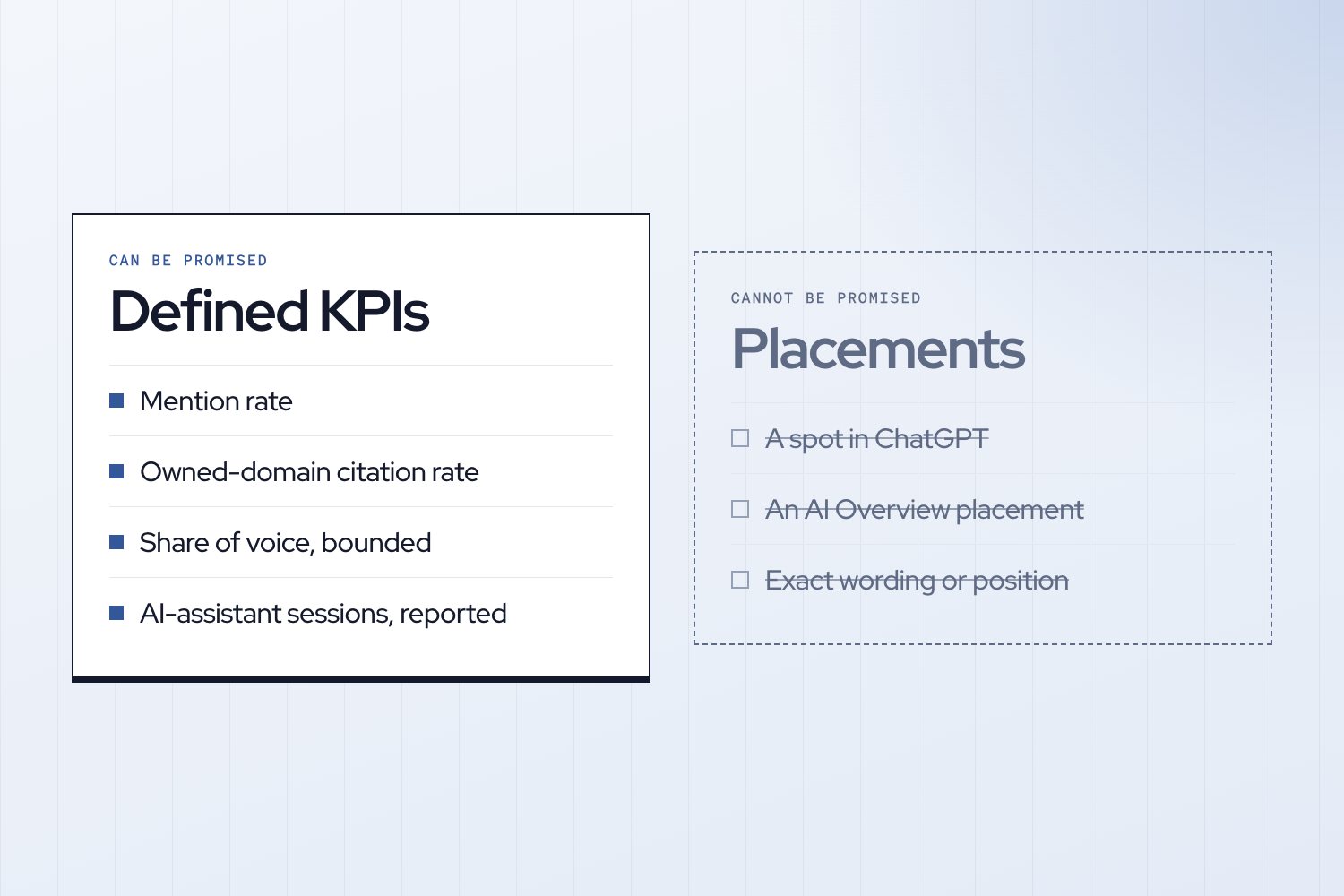
- Agencies should sell a documented next step and transparent remeasurement plan, not guaranteed rankings, citations or revenue.[16]
Table of contents
- What is an AI visibility audit for prospects?
- What should a small GEO pitch audit test?
- How many engines should an agency use?
- How should agencies show competitors that appear instead?
- What does a seven-step GEO sales audit process look like?
- How should the audit findings be presented in the pitch meeting?
- How should an agency turn findings into a scoped proposal?
- Should an agency offer a free or paid GEO audit?
- How can agencies avoid overclaiming from a single run?
- FAQ
- Sources
A GEO pitch audit is a small, documented test of how a prospect and its competitors appear in AI-generated answers. Used properly, it gives an agency a concrete sales conversation: which buyer questions were tested, which competitors appeared instead, which sources were cited, and what further diagnosis or implementation could address the gap.[1]
It does not prove that the prospect is universally invisible, predict revenue, or establish that the agency’s future work will change AI results. AI answers can vary substantially between repeated runs, including on the same day, so a pitch audit should be presented as a bounded snapshot rather than a market-wide score.[2]
Agencies can use the audit to win attention by doing four things:
- Test realistic, unbranded buyer questions rather than only prompts that contain the prospect’s name.[3]
- Show the actual answers and cited sources, including competitors that appear where the prospect does not.[2]
- State the engines, prompts, dates, markets and limitations clearly.[4]
- Convert the observed gap into a scoped diagnostic or implementation proposal, not a guarantee of rankings or revenue.[5][3]
What is an AI visibility audit for prospects?
An AI visibility audit measures what selected AI engines return for a defined set of prompts. The audit may record whether the prospect is named, whether its domain is cited, which competitors appear, which sources are referenced and how the answers differ between engines.[3][1]
For new business, the objective is not to produce a comprehensive benchmark before discovery. It is to make one buyer-relevant problem inspectable. A useful audit answers questions such as:
- Does the prospect appear for important category questions?
- Which competitors are recommended instead?
- Does the prospect appear but lack a supporting domain citation?
- Which third-party pages do AI engines cite?
- Are the answers accurate, incomplete or misleading?
- Is the evidence strong enough for a free snapshot, or does the prospect need a paid diagnostic?
Industry research shows growing demand for AEO and AI-search services, but it does not establish that free audits produce a particular close rate. AgencyAnalytics reports that 66% of surveyed agency professionals saw increased demand for AEO or AI-search services, while the available agency research does not publish an audit-to-client conversion rate.[6]
What should a small GEO pitch audit test?
Start with the prospect’s real buying context. Generic prompts can produce generic findings, while buyer-specific questions reveal whether the prospect is present when a potential customer needs a recommendation.[7][2]
A compact prospect audit should normally include three prompt groups:
-
Unbranded category questions
Test questions a buyer could ask without knowing the prospect. Examples include “What are the best [category] providers for [use case]?” and “Which [category] solution is suitable for a company with [constraint]?” These questions test discovery, not brand recognition.[1] -
Use-case and constraint questions
Test the prospect’s strongest markets, audiences, use cases and differentiators. These prompts show whether the prospect is visible for a commercially meaningful need rather than merely appearing for a broad category term.[3] -
Brand-direct questions
Test questions that explicitly mention the prospect. Keep these separate from unbranded discovery questions because they measure representation and accuracy rather than open-market discovery.[3]
Jincove recommends keeping brand-direct prompts below one fifth of the total set and deciding in advance whether the audit counts a brand mention, a domain citation or both as success.[3]
Use real competitors wherever possible. If the prospect has supplied a competitive set, use it; otherwise, identify the brands that repeatedly appear in the initial category answers. Do not call every appearing brand a commercial competitor without checking the category and business model.
| Audit element | What to test | Time needed | What it proves and what it does not |
|---|---|---|---|
| Buyer questions | 8–12 realistic, unbranded and use-case prompts | 30–60 minutes | Shows results for the selected questions; does not measure every buyer journey.[8][2] |
| Brand-direct questions | 1–2 prompts naming the prospect | 5–10 minutes | Tests representation and accuracy; does not prove open-market visibility.[9][3] |
| Competitor presence | Which competitors are named, ranked or recommended | 15–30 minutes | Shows who appears in the sampled answers; does not establish total competitor share.[1] |
| Domain citations | Whether the prospect’s domain is cited and which third-party sources appear | 15–30 minutes | Identifies citation and source gaps; does not prove that publishing one page will secure a citation.[3][1] |
| Engine comparison | At least two, ideally three, models from different providers | 20–45 minutes | Reveals cross-engine differences; does not create a universal engine ranking.[1][3] |
| Repeated runs | Repeat the highest-value prompts under recorded conditions | 30–90 minutes | Shows recurrence or volatility; does not eliminate uncertainty.[2] |
| Evidence pack | Save prompts, answers, URLs, dates, engines and screenshots or exports | 15–30 minutes | Makes findings inspectable and reproducible; does not turn a snapshot into a longitudinal baseline.[3] |
The Dice Roll Method recommends testing at least two, ideally three, models from different providers and using a pilot to estimate variance.[9] For a short sales audit, that is a defensible starting point, not a mandatory universal minimum.
How many engines should an agency use?
For a first prospect conversation, use two or three engines from different providers if the workflow permits it. A practical set might include ChatGPT, Google AI Mode or AI Overviews, and Perplexity, but the best selection depends on the prospect’s market, audience and available access.[2]
The important point is comparability. Record:
- Engine and product surface.
- Date and approximate time.
- Country, language and device or account conditions where relevant.
- Exact prompt wording.
- Whether browsing or personalization was enabled.
- Full answer text.
- Cited URLs.
- Prospect and competitor mentions.
- Any repeated-run results.
Google AI Mode, Google AI Overviews and a conversational assistant should not automatically be treated as identical products. If the audit combines them, label each result by surface rather than presenting one blended score.
A single response can establish that an engine returned a particular answer under recorded conditions. It cannot establish what every buyer sees. Research covering repeated AI-search observations found substantial source variation, including same-day variation, and recommends repeated observations when stronger measurement is required.[2][9]
How should agencies show competitors that appear instead?
Lead with the buyer question, not the agency’s tool or score. Show:
- The exact question.
- The engine and date.
- A short excerpt or screenshot of the answer.
- Which competitors appeared.
- Whether the prospect was named.
- Whether the prospect’s domain was cited.
- The sources the engine used.
- The commercial implication.
A useful classification separates naming from citation:
| Prospect named? | Prospect domain cited? | How to describe the result |
|---|---|---|
| Yes | Yes | The prospect appears and its domain supports the answer. |
| Yes | No | The prospect is mentioned, but the answer does not cite its domain. |
| No | Yes | The domain is used as a source without naming the brand. |
| No | No | The prospect is absent from the answer and its domain is not cited.[10][9] |
Then show the competitor substitution. For example:
“For this buyer question, Competitor A and Competitor B were recommended. The prospect was not named. The answer cited a comparison article and an industry directory.”
That statement is stronger than “your brand has poor AI visibility” because it identifies the precise observation. It also opens several possible workstreams: source analysis, content improvement, digital PR, technical access, reputation or further prompt research.
Do not imply that the competitor caused the prospect’s absence. The audit shows what appeared in the tested answer, not why the engine selected those brands. Causal explanations require further investigation.
What does a seven-step GEO sales audit process look like?
-
Choose one commercial theme.
Select a product, market, audience or use case that matters to the prospect. Avoid attempting to audit the entire business before the first meeting. -
Build a balanced prompt set.
Use mostly unbranded buyer questions, add use-case prompts and include only a small number of brand-direct questions.[3] -
Select two or three engines.
Use different providers or surfaces where possible, and record the exact configuration.[3][1] -
Run the prompts and save raw evidence.
Retain the full answers, citations, dates and engine labels. Do not rely only on a dashboard score or manually remembered result.[1] -
Repeat the most important observations.
Rerun prompts where the commercial implication is strongest, especially where a competitor appears and the prospect does not. Label the result as recurring, mixed or observed once.[9][2] -
Classify the gaps.
Separate missing mentions, missing citations, inaccurate claims, weak competitor positioning and source gaps. Do not collapse all of them into one visibility number.[9] -
Turn findings into a scoped next step.
Offer a defined diagnostic or implementation proposal with deliverables, prompts, engines, markets, timeline and remeasurement plan. Keep the promise tied to the work, not to guaranteed AI outcomes.[11]
The final step is where an audit becomes a sales asset. “Improve AI visibility” is too broad to scope. “Diagnose why the prospect is absent for 12 category prompts across three engines, map the cited sources and produce a prioritized content and digital-PR plan” is a defined engagement.
How should the audit findings be presented in the pitch meeting?
Use one slide to create a clear transition from evidence to action.
One-slide outline: “Where buyers see competitors instead”
- Headline: “Competitors appear for three high-value buyer questions while [Prospect] is inconsistently present.”
- Scope: 10 prompts, three engines, date range, market and language.
- Left column: Two or three exact buyer questions.
- Middle column: Prospect, competitor and citation results.
- Right column: The strongest cited sources and the apparent gap.
- Evidence link: QR code, appendix or shared document containing full answers and URLs.
- Caveat: “This is a directional snapshot, not a complete measure of AI visibility or business impact.”
- Decision: “Next step: a defined diagnostic to validate the pattern and prioritize action.”
A documented Peec pitch-slide workflow uses a prospect’s visibility profile, top competitors, share of voice, strongest and weakest models, and prompts where competitors win.[12] That structure is useful, but a small agency audit should not imply that it has 30 days of history unless it actually does.
Keep the slide visually simple. One strong competitor example is more persuasive than a crowded dashboard. Put additional prompts and raw answers in an appendix so the prospect can inspect the evidence without losing the narrative.
How should an agency turn findings into a scoped proposal?
Map each finding to a hypothesis, work package and measurement plan.
| Finding | Possible hypothesis | Scoped follow-up |
|---|---|---|
| Prospect absent from unbranded category prompts | Relevant pages may not clearly address the buyer question or may lack supporting sources | Content and source audit for the tested topic cluster |
| Prospect named but domain not cited | The answer recognizes the brand but does not use its owned content as evidence | Citation-source and content-structure analysis |
| Competitors repeatedly cited | Competitors may have stronger third-party coverage or more extractable content | Competitor source mapping and digital-PR/content plan |
| Answer contains inaccurate claims | Existing public information may be incomplete, contradictory or poorly structured | Accuracy review, source correction and reputation work |
| Results differ sharply by engine | The finding may be engine-specific or unstable | Repeated baseline across selected engines and prompts |
| AI crawlers or referral traffic are unknown | The agency lacks evidence about access and downstream visits | Bot analytics, AI referral and attribution setup where available |
A proposal should state:
- The exact prompt set.
- Engines and markets.
- Number of repetitions.
- Data and evidence retained.
- Deliverables.
- Client inputs required.
- Timeline.
- Remeasurement method.
- What the agency will not claim.
The proposal should also distinguish diagnosis from implementation. Blair Enns describes a paid diagnostic as a first phase that fills information gaps and produces findings and recommendations for a later multi-option proposal.[13] First Page Sage reports a $1,500–$12,000 range and $4,300 median for one-time GEO/AEO audits, typically lasting two to six weeks, but that benchmark describes delivered audit work rather than a required fee for a short prospect scan.[14]
Should an agency offer a free or paid GEO audit?
Use a free audit when the purpose is to demonstrate a specific, limited opportunity. Charge when the prospect expects research depth, strategic interpretation, implementation priorities, stakeholder-ready documentation or repeated measurement.
Free versus paid GEO audits
A free prospect snapshot can include:
- A small prompt set.
- Two or three engines.
- One market and language.
- A few competitor examples.
- Selected raw answers and cited URLs.
- A short meeting discussion.
- A clear boundary that the result is directional.
A paid diagnostic can include:
- Discovery and buyer-question development.
- A larger prompt library.
- More engines, markets or languages.
- Repeated runs and variance analysis.
- Competitor and source mapping.
- Accuracy and reputation review.
- Prioritized recommendations.
- A documented implementation roadmap.
- Baseline storage and remeasurement design.
Commercial rule: Do not give away an implementation-ready strategy under the label of a free audit. If the work requires substantial analysis, define it as a paid diagnostic with a deliverable and a decision point.[15]
There is no published evidence that free GEO audits close more clients than paid diagnostics. Agency surveys establish demand and different packaging models, but not a causal audit-to-client conversion rate.[3]
The market also supports more than one packaging model. Demand-Genius reports that some agencies are developing standalone GEO offerings, while other practitioners describe GEO reporting as part of an existing PR retainer.[16] Mavlers reports that 63% of surveyed agencies bundle AEO/GEO into an existing retainer and 6% sell it standalone, although its public methodology does not disclose enough detail to generalize those figures to every agency.[17]
How can agencies avoid overclaiming from a single run?
Use precise language. Prefer:
- “In the tested answers…”
- “For these prompts and engines…”
- “The prospect was not named in two of three runs.”
- “Competitor B appeared in the saved response.”
- “This is a directional snapshot.”
- “We recommend validating the pattern with repeated measurement.”
Avoid:
- “Your brand is invisible everywhere.”
- “AI engines do not trust your website.”
- “This change will make you rank in ChatGPT.”
- “Competitor B owns AI search.”
- “The audit proves lost revenue.”
- “Our work will guarantee citations.”
AMEC recommends documenting tools, prompts, platforms, dates, markets and languages, repeating tests with variation disclosed, and saving outputs.[4] It also distinguishes information readiness from what audiences actually see in AI answers. That distinction matters: a technically accessible page may still not be cited, while a third-party source may influence an answer without the prospect controlling it. Accessibility is still worth checking before assuming a content gap: Finseo’s audit of AI crawler readability found that 8.9% of 20,293 pages on 524 sites returned nothing readable to AI crawlers.
A strong audit report includes an uncertainty note:
“Results reflect the recorded answers returned for the listed prompts, engines and dates. AI outputs can vary. The findings indicate opportunities for further diagnosis; they do not estimate total visibility, revenue impact or causal effect.”
Frequently asked questions
What is a GEO pitch audit?
A GEO pitch audit is a limited AI visibility assessment prepared for a prospective client. It tests selected buyer questions across selected AI engines and records mentions, citations, competitors and source URLs.[3]
How many prompts should an agency use for a free AI visibility audit?
A practical small audit can begin with roughly 8–12 buyer questions, plus one or two brand-direct prompts. Jincove describes a one-hour mini-audit using 10 prompts and one engine, while Promptwatch’s agency report defaults to 10 prompts across three models; these are workflow recommendations rather than scientifically established minimums.[3]
How many AI engines should a prospect audit include?
Use at least two, and ideally three, engines from different providers when the audit’s purpose is comparison. The Dice Roll Method recommends that range, but the recommendation is a protocol for repeated-query auditing rather than a universal sales standard.[9]
Can a single AI answer prove that a prospect is invisible?
No. A single answer proves only what one engine returned for one prompt under the recorded conditions. Repeated-run research finds substantial variation in AI-generated sources and recommendations, including within the same day.[2]
Should agencies charge for a GEO audit?
Charge when the work includes substantial discovery, repeated measurement, interpretation, recommendations or implementation planning. A free snapshot can be appropriate when it is small, bounded and designed to open a sales conversation.[9]
Sources
- [1]How to Run a Free AI Visibility Audit with Semrush — semrush.com
- [2]arxiv.org — arxiv.org
- [3]The GEO Audit Checklist for Agencies in 2026 | Jincove — jincove.com
- [4]The AMEC GEO Principles — amecorg.com
- [5]GEO for agencies: pitch, win, and report on clients — promptwatch.com
- [6]2026 Marketing Agency Benchmarks Report - AgencyAnalytics — agencyanalytics.com
- [7]Managing your projects — docs.peec.ai
- [8]Free GEO Report | Peec AI — peec.ai
- [9]The Dice Roll Method: A Standardized Protocol for Repeated-Query Auditing of Large Language Model Brand Recommendations — arxiv.org
- [10]Get a free Brand Report with OtterlyAI — otterly.ai
- [11]First Do No Harm — winwithoutpitching.com
- [12]Build Live Data Pitch Slides - Peec AI MCP Use Case — peec.ai
- [13]The Answer Is Sell A Diagnostic — winwithoutpitching.com
- [14]GEO & AEO Pricing Statistics: 2026 Report – First Page Sage — firstpagesage.com
- [15]Fixing Your Consulting Firm’s Valuable-Yet-Unsellable Offering - David A. Fields Consulting Group — davidafields.com
- [16]Selling GEO Report — pub-39c4e13fd6aa4eb2a136970e821e69d5.r2.dev
- [17]AEO/GEO Agency Survey: Free Report on How Agencies Sell — mavlers.agency
- [18]Customizable AI visibility reporting for agencies | Semrush — semrush.com